
Custom Blade Element Momentum Simulator
Description
This project is a Python-based Blade Element Momentum simulator for custom wind turbine blade design, built to connect interactive geometry creation with detailed aerodynamic analysis. Users can define blade shapes through a GUI, generate sectional aerodynamic information using NeuralFoil-based polars, and evaluate resulting performance across wind speeds, tip-speed ratios, and operating conditions.
The code combines radial blade discretization, induction-factor iteration, and performance postprocessing into a cohesive workflow for design exploration. With contour plots, heatmaps, and Cp-vs-TSR studies, the project functions as a numerical and visualization environment for understanding how geometry and aerodynamic assumptions shape thrust, torque, power, and efficiency.
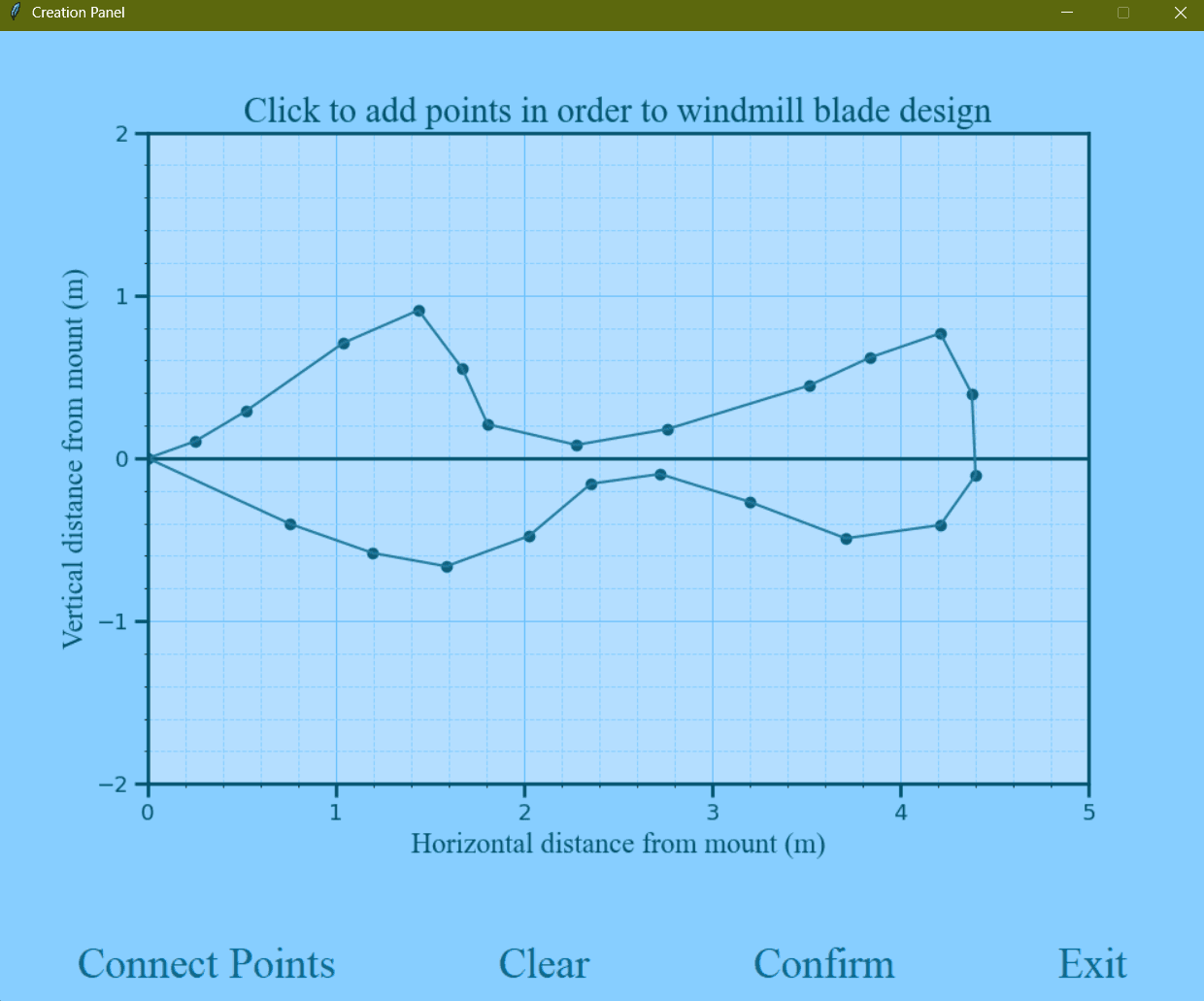
- Built a GUI workflow for user-defined wind turbine blade geometry and simulation control.
- Implemented Blade Element Momentum analysis with sectional induction-factor iteration and aerodynamic convergence logic.
- Integrated NeuralFoil-generated polar data for angle-of-attack and Reynolds-dependent aerodynamic behavior.
- Added performance diagnostics including thrust, torque, power, and power-coefficient heatmaps and contours.
- Generated Cp-vs-TSR studies and modular visualizations for blade-performance evaluation.
Highlights and Learning Experiences
Blade geometry design interface
A GUI for drawing and configuring custom blade profiles before aerodynamic analysis.
Aerodynamic performance maps
Heatmaps and contour plots for thrust, torque, power, and power coefficient across operating conditions.
Sectional and TSR analysis
Radial discretization and Cp-vs-TSR studies for evaluating blade efficiency and operating behavior.