MIISO: Modal integrators for Isogeometric Stabilization of Outliers
Developed a new class of numerical ODE methods for isogeometric analysis that target the spline space outlier problem in structural simulations. The methods are based on non-holormphic blends of Padé approximants of the exponential function and form a family of modified exponential Rosenbrock–Krylov schemes, called MIISO, constructed matrix-free for efficient implementation and backed by rigorous theoretical proofs. Available on arXiv and currently in review in Computer Methods in Applied Mechanics and Engineering.
arXiv:2609.25087
Pseudospectral methods for nonlinear hyperbolic PDEs
Studied shocks, weak solutions, and entropy conditions in nonlinear hyperbolic problems, along with numerical approaches such as spectral and entropy viscosity and filtering for discontinuous solutions, with the goal of producing entropy-stable, accurate solutions and mitigating Gibbs phenomena. Looked into new approaches for achieving stable simulations, and plan to revisit at a later time.
Nonlinear stability analysis of positivity-preserving hyperbolic schemes
Attempted to develop a framework for nonlinear fully discrete stability analysis of hyperbolic PDE solvers, motivated by positivity-preserving time integration. Looked into extensions of von Neumann analysis toward state-dependent spectral behavior, with the goal of analyzing how spatial discretizations and time integrators interact in nonlinear settings.
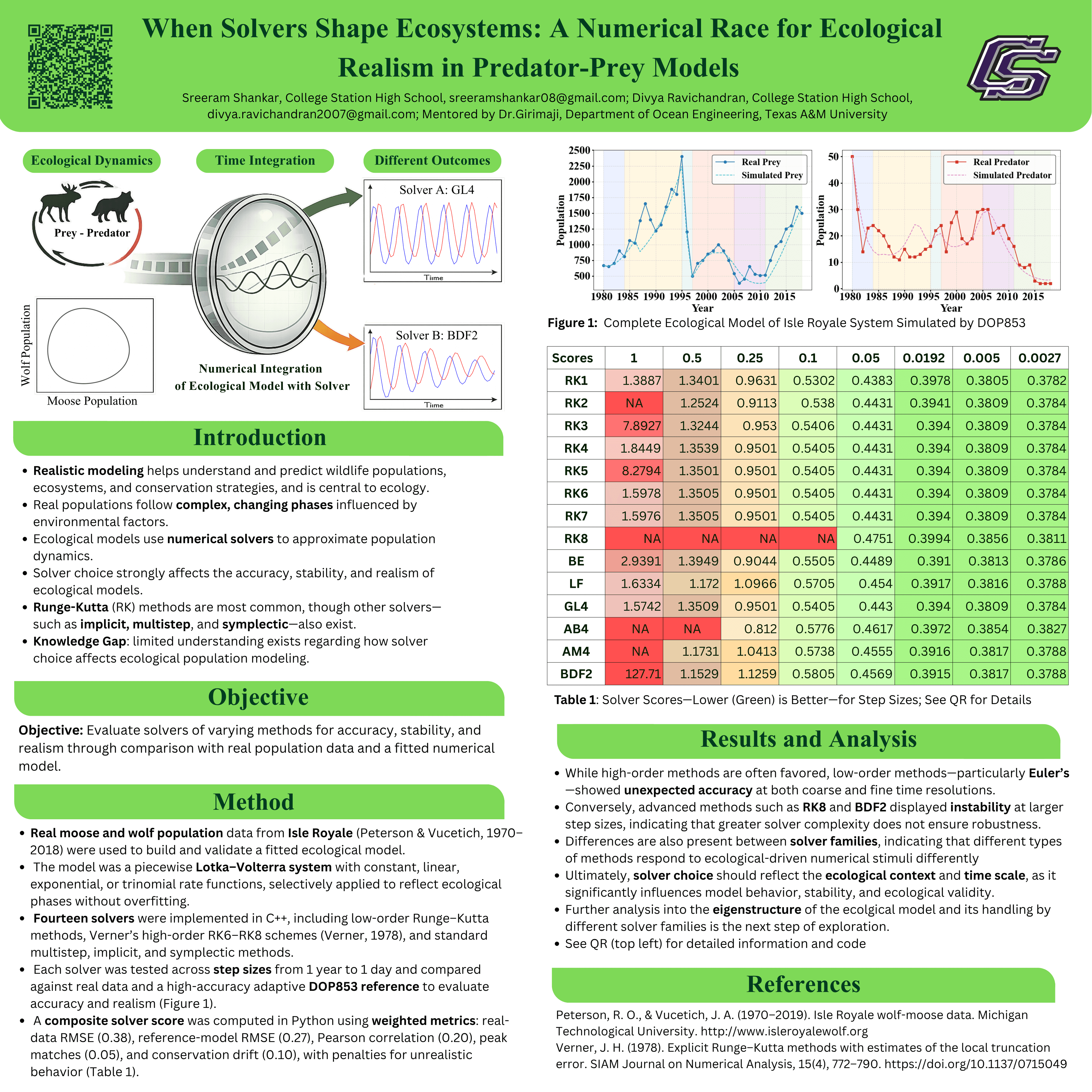
Solver-dependent ecological dynamics in predator–prey models
My first research: investigated how numerical solver choice influences the qualitative and quantitative behavior of predator–prey models fit to real ecological data. The project compared explicit, implicit, multistep, and Runge–Kutta methods in terms of stability, accuracy, and ecological realism, and later extended into spectral analysis focused on the eigensystem behavior induced by different time integrators.