
Stochastic Chemical Dynamics Testbed

Description
This project is a carefully designed numerical framework for simulating and analyzing stochastic chemical reaction dynamics, with emphasis on reproducibility, numerical control, and method comparison rather than raw performance. The current implementation centers on the bistable Schlögl reaction system and provides both exact stochastic simulation through Gillespie SSA and diffusion-based modeling through the Chemical Langevin Equation.
A core design principle of the framework is that randomness is treated as an explicit input rather than a hidden side effect. By decoupling and freezing noise sources, the code makes solver-induced differences attributable to modeling and numerical choices instead of uncontrolled randomness. The result is a trustworthy numerical laboratory for studying approximation error, solver bias, switching statistics, and stochastic-deterministic tradeoffs in a highly reproducible setting.
- Implemented exact SSA and CLE-based stochastic simulation within a shared, reproducible numerical framework.
- Added multiple deterministic and stochastic integrator families, including true step methods and explicit operator-splitting workflows.
- Designed a fixed-seed randomness architecture so solver comparisons remain fair, decoupled, and exactly reproducible.
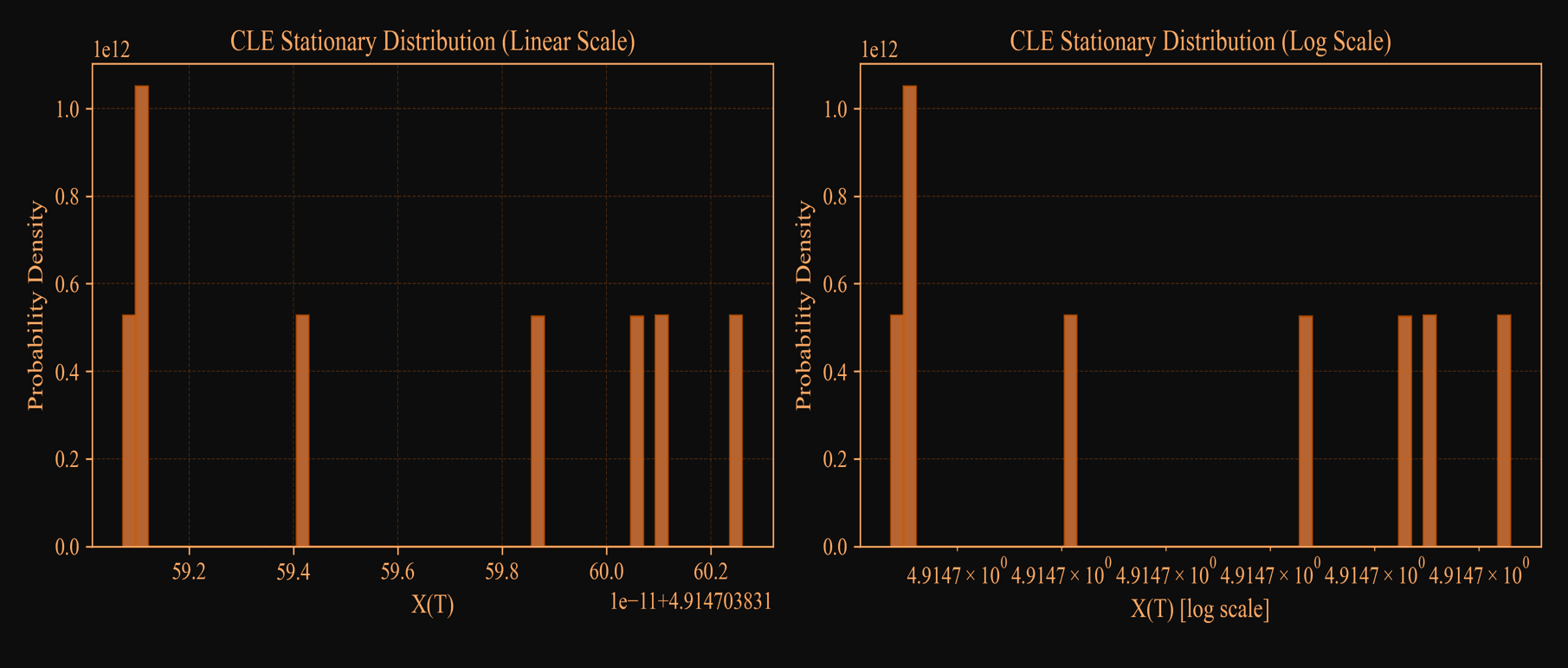
- Built diagnostics for trajectories, moments, stationary distributions, switching behavior, and SSA-vs-CLE validation.
- Structured the project as a research-oriented testbed for studying solver-induced bias and approximation error in stochastic systems.
Highlights and Learning Experiences
SSA and CLE comparison workflows
A reproducible numerical framework for comparing exact stochastic simulation with diffusion approximations under controlled randomness.
Integrator and splitting experiments
Side-by-side comparison of deterministic and stochastic integrator families, including operator splitting strategies.
Diagnostics and visualization suite
Trajectory, distribution, switching, bias, and solver-comparison diagnostics for fast exploratory analysis and validation.